

Water condensation in a tarpaulin hall: Why it occurs and how to solve it
Sometimes, in a tarpaulin hallsmall droplets…
Read more >>
Industrial halls play a very important role in various areas of business. They serve not only for storing goods or equipment, but also as an important background for production technologies, logistics, operations and office environments.The correct choice of the structure and type of industrial hall can significantly affect the efficiency of operations, but also of the entire manufacturing enterprise.
By choosing the right industrial hall you can reduce maintenance, heating, cooling costs and simplify future expansion of the hall. Among the most popular and cost-effective solutions are, for example, tarpaulin halls, which are characterized by quick construction, flexibility and low costs.
In this article, we will look at the main factors that play a role in choosing an industrial hall, what types of structures are the best, what affects the price and what trends are currently moving the world of industrial halls.
What factors play a role in choosing an industrial hall? Each project is unique in itself. When choosing an industrial hall, you should consider several basic parameters:
Unequivocallythe most common choice for large companies, manufacturing plants, large industrial halls or complexes. Steel structures are very strong, durable and allow you to create halls with a large span without internal supports. They excel in quick construction and very long service life.
Aluminum halls are lighter and more flexible than steel halls. These types of buildings are especially suitable for temporary, seasonal operations or small businesses. Their advantage is lower weight and quick assembly. On the other hand, this material is very expensive and is not suitable for the construction of large halls, as the construction itself becomes significantly more expensive.
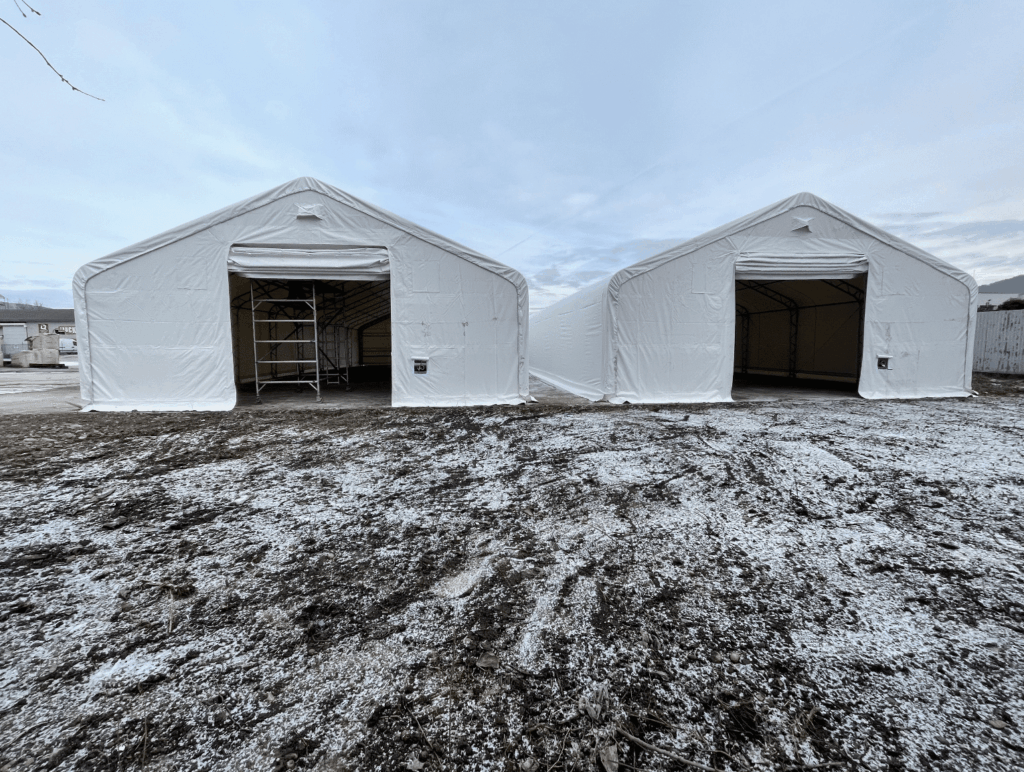
This is anaffordable solution with quick implementation practically anywhere. Tarpaulin halls are ideal for storing goods, for agricultural purposes or for garageing various machines (e.g. garden, maintenance or agricultural equipment). Modern tarpaulin halls now meet higher requirements for resistance to UV radiation, wind or snow.
Thesemassive reinforced concrete hallsare suitable for specific types of production where high fire resistance and permanent strength are required. Although their construction is slower, the investment will pay off in long-term stability and quality thatwill last for several decades.
These are prefabricated halls, the individual parts of which are manufactured in advance in the production plant and then assembled directly on site. This method significantly speeds up construction and reduces dependence on the weather. Prefabricated halls can be steel, concrete or combined and are often used where speed of construction and accuracy are important. Their advantage is also the high quality of processing of individual parts and the possibility of repeated production of the same elements. You can find out more information on this topic in the article – Prefabricated buildings: Modern construction solutions for fast and efficient construction.
Sandwich panels with PUR foam filling (polyurethane)are an increasingly popular solution for insulated halls. They are characterized by excellent thermal insulation properties, low weight and quick assembly. Sandwich halls are ideal for warehouses, production facilities or cold storage areas. In addition to energy savings, they also offer a modern look and a long service life without the need for demanding maintenance. If you are looking for a quality solution of this type, read the article – Prefabricated hall made of PUR panels: Everything you need to know, which combine functionality and quick implementation.
The frequently asked question “How much does an industrial hall cost?” cannot be answered unequivocally. The price depends on several factors. One of the key ones is the type of construction – tarpaulin halls are among the most affordable solutions, and conversely, reinforced concrete halls are among the most expensive. On the other hand, you should also consider the size of the building – the larger the area, the higher the costs of building such a hall.
The technical design also plays an important role. If the hall needs to be insulated, soundproofed or meet strict safety standards, sandwich panels made of PUR foam are an excellent option. Another significant expense is the interior equipment – industrial lighting, air conditioning, cooling and heating, cranes and conveyors, the thickness of the concrete floor (for high or low loads), and the distribution of utility networks (water, gas, electricity, sewage). These elements can significantly increase the final price of an industrial hall.
The impact of the price of the land itself is often underestimated.Landscaping, consolidation and alignment, slope conditions and subsoil typealso have an impact on the final price. For this reason, it is important to approach budget planning comprehensively and take these items into account. If you would like to learn more, read the article – How to level land: Flat, sloping and bumpy.
Similar to other areas, industrial halls are subject to modern trends. In recent years, the following areas have become increasingly popular:
Choosing the right industrial hall is a complex process in which many factors play a role – from the type of operation to the company’s long-term plans. Whether you decide on a reinforced concrete or steel hall structure, always think ahead. Industrial halls are an investment that should serve reliably and efficiently for several years.
If you are looking for professional advice or need help with the design and implementation of a custom-made hall, contact us – we will be happy to help you choose a structure that will suit your needs and budget.