



Workshop organization: Workshop, garage organization and tool storage
|
Workshop organization is a system where each tool has a specific place, is immediately available, and work is done without lengthy searching. Proper workshop organization reduces the time spent searching for tools by up to 60% and increases work efficiency. According to a study by the National Association of Productivity and Organizing Professionals (NAPO)craftsmen in an unorganized space spend 10% of their working time just looking for tools,which is almost 50 minutes a day. In practice, this means that a quality workshop layout can save more than 200 hours per year.
Based on our practical experience, we know that even a smaller workshop can function effectively if it has a clear structure, logical division of space and appropriately designed tool storage, for example using shelves. This article will show you specific procedures that work in real conditions.
Workshop organization: Basic principles
By organizing your workshop correctly, you will divide the space so that each tool has its own fixed place, is immediately accessible, and there are no unnecessary movements during work.
The basis is the division of the workshop into practical zones. Let’s take a look at what the basic division of work areas should be:
- Work zone: table, vice and the main tools that you normally use.
- Storage zone: shelves, cabinets, boxes and storage space.
- Zone for large tools: saws, compressor, welder, lawn mower, etc.
- Zone for consumables: screws, dowels, chemical anchors, etc.
According to our experience, such a workshop arrangement increases work efficiency by 15 to 25% and at the same time reduces the time needed to perform individual work tasks. The tools you use most often should be at a height of 80 to 140 cm. It is at this height that access is the fastest, most natural and at the same time you do not strain your spine and shoulders.
Based on our many years of experience, we recommend using specially designed perforated walls and shelf racks. These can increase transparency by up to 40%, improve orientation and reduce the risk of losing tools. Visual overview is a key factor that significantly speeds up work.
Table: Recommended workshop space distribution
See the clear table of recommended workshop space distribution, which improves work flow and minimizes unnecessary movements.
| Zone | Recommended area | Importance |
| Work zone | style=”font-weight: 400;”>40 % | Main work operations |
| Storage | 30 % | Shelves, cabinets, boxes |
| Large tools | 20 % | Machines and larger equipment |
| Reserve | 10 % | Manipulation and movement |
Workshop order: How to maintain it in the long term?
In our experience, workshop order is not a one-time thing, but a system that must function daily. If the order and organization of the workshop is to function in the long term, it is necessary to set clear rules. These should be followed for every job, regardless of whether it is a quick repair or a project lasting several days.
Follow the basic rule: every tool must have its place.After the job is done, it always returns to the same place. This principle can cut the search time by up to half, while also reducing your stress, wear and tear and damage to the tools due to improper storage. We recommend using markings, whether colored or by category, so that it is immediately visible what is missing and where it belongs.
The order in the workshop also significantly affects safety.Up to 25% of accidents in the workshop are related to obstacles on the floor or poorly stored tools. This problem often also affects larger work spaces, such as ship containers used as a workshop or warehouse. Even in such a space, proper workshop organization can improve orientation, reduce the risk of injury, and increase work comfort.
Don’t know how to start keeping your garage tidy? We recommend that you implement a simple control system that includes a short clean-up at the end of the working day, regular reorganization and occasional checking of the condition of the tools.
Organizing the garage: Efficient space layout
Organizing the garage means making the most of the available space without restricting movement or parking and ensuring that each tool and equipment has its fixed place. Properly organizing the garage workshop also reduces the time it takes to find tools and improves safety at work.
The average garage has an area of 18 to 24 m², but up to 30% of the space remains unused. The greatest potential is in vertical space, where it is possible to use shelf racks, hanging systems or wall brackets. This principle is also used in spaces such as 6-meter and 12-meter shipping containers converted into a workshop, where the correct layout of equipment can significantly increase the usability of the space and the comfort of work.
The tools you use daily belong at arm’s length, while seasonal or less frequently used equipment is suitable Store higher or in the back of the space. This arrangement of the workshop reduces unnecessary movements and improves the flow of work.
According to our experience, the correct arrangement of the workshop, even in the garage, can increase the usable space by 30%, which in practice means the ability to store more equipment without having to increase the space. A free space of at least 60 cm for movement is also important, which ensures safe handling and reduces the risk of accidents.
Tool storage: What are the best solutions?
Proper storage of tools will ensure quick availability, longer service life, reduce search time and help prevent damage.
The best solutions in our experience include perforated panels, metal cabinets, plastic boxes, mobile workshop trolleys and especially shelf racks, which are among the most effective storage systems. Shelves allow for clear storage of tools, quick access and maximum use of space, which is especially important in smaller workshops or container spaces. A practical solution can be, for example, a workshop workbench, a tool wall (suitable for smaller tools: screws, nuts, hammers, pliers, combination wrenches, screwdrivers, etc.), magnetic rails and bowls, tool trolleys, storage boxes and organizers.
The biggest risk of poor storage is moisture, dust and incorrect storage. Power tools should be stored dry at a humidity below 60%, because higher humidity significantly increases the risk of corrosion, damage to electronics and reduced device performance. We also recommend dividing your tools into basic categories, such as hand tools, power tools, measuring tools, and fasteners, with each category having its own designated place. This workshop layout improves orientation, speeds up work, and creates a professional and safe working environment. If you are interested in this topic, read the article: Tool storage and garden tool storage.
Conclusion: Workshop organization will make your work easier
Workshop organization has a direct impact on the efficiency, safety, and lifespan of your tools. A properly designed space can reduce the time it takes to find tools, improve visibility, and increase work comfort. Always start with simple steps, such as dividing the space or marking places.
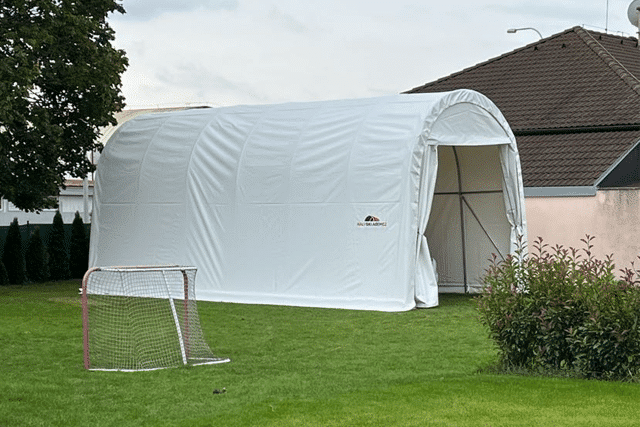
An interesting solution can also be modular spaces, e.g. tarpaulin halls or shipping containers available at hagro.sk, which you can use for a functional workshop or garage. A well-designed workshop layout is an investment that will pay off in time savings, increased safety and more efficient work.
FAQ
Reduces time searching for tools, increases safety and improves work efficiency. By introducing a system where each tool has a fixed place and regular checks. By using shelves, wall systems and effective use of vertical space. Dry, clearly divided by type and protected from moisture and damage.
Other articles

Shipping container cottage: How to save on building a cottage?
Building your own cottage does not…
Read more >>

Hagro is expanding! Discover premium scaffolding for your projects at Svetlesenia.sk
At Hagro, we have always emphasized…
Read more >>

Insulated prefabricated halls or tarpaulin halls? Which is better for you?
Insulated prefabricated halls are used quite…
Read more >>