


Storing grain and cereals for maximum shelf life
|
Grain is very important in agriculture and the food industry, so its proper storage is extremely important to maintain its quality and not be damaged by pests. How to properly store grain and cereals?
How can proper storage increase the shelf life of grain

Grain and cereals are a key part of human civilization. They are a basic source of food, energy, and they also play a huge role in the food industry and economy. Growing, processing, and storing grain and cereals is a complex process that requires knowledge, skills, and technology. Proper storage is of course key to maintaining its quality and extending its shelf life. Improper storage of grain and cereals seriously degrades this crop, as it makes the grains susceptible to pest infestation, provides a great breeding ground for mold, and of course, loses its nutritional value.
The most dangerous pests that are attracted to cereals are the grain beetle, the grain mealybug, and the grain moth. These beetles overwinter as adults in warehouses or in nature, waiting for ideal conditions for reproduction. These occur at temperatures between 18 and 35 °C and air humidity of around 90%. So, it is of course clear from this that storing grain and cereals in such conditions is not a good solution, and therefore storage requires completely different conditions. How to store grain properly? Read what to avoid and also about the alternative of storing grain in the form of tarpaulin halls.
Principles to follow when storing grain and cereals
If you want to store grain and cereals properly, you should do so based on several important principles. By following them, you will ensure that your harvest will be stored properly, will not be attacked by any pests or mold, and thus minimize losses to your harvest.
- Store only healthy and especially dry grain. Definitely do not store grains that are damaged, moldy or infested with pests.
- Moisture-free environment. Grain and cereals should be stored in a dry environment, as moisture can cause mold growth, faster pest reproduction, which of course causes crop deterioration.
- Ensure optimal temperature conditions. Maintaining the appropriate temperature is key to preserving grain quality. Ideal temperatures vary depending on the type of grain, but in general, it is good to store them in a cooler environment, which means a temperature of around 10 degrees Celsius.
- Sufficient ventilation is important. When storing grain and cereals, it is necessary to ensure good ventilation, which helps to keep the storage areas dry.
- Regularly check stored grain. Regularly inspect your grain for any signs of damage, mold, or pest infestation.
What to avoid when storing grain
Improper humidity
High humidity encourages the growth of mold and bacteria that break down grains and produce toxins. These toxins reduce the quality of the grain and can be harmful to human and animal health. In addition, high humidity can lead to grain germination, which reduces its nutritional value and taste. On the other hand, low humidity can lead to drying of the grain and loss of its nutritional value.
Incorrect temperature
High temperatures reduce the shelf life of grain, as they are a great opportunity for stored grain and cereals to be attacked by pests at such temperatures.
Insufficient control
For example, temperature or humidity. Without monitoring and adjusting the humidity and temperature in storage areas or, for example, in tarpaulin halls, there is a risk that the grain will be exposed to poor conditions that will deteriorate it. Insufficient control for the presence of pests is also a problem. Regular inspection of grain for the presence of insects and rodents is important, because early detection leads to a faster resolution and management of the situation.
Improper storage
For example, if grain is stored in direct sunlight or good ventilation of the premises is not ensured. Mixing different types of grain with different moisture content is also a problem.
A tarpaulin hall as a suitable option for storing grain
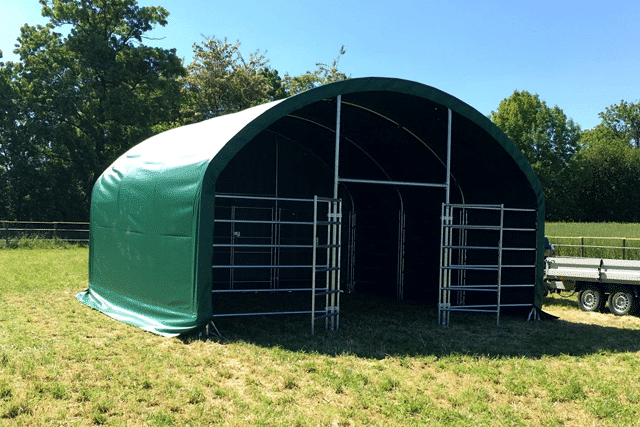
Currently, more and more farmers and food producers are turning to tarpaulin halls as a suitable alternative for storing grain and cereals. In addition, they are also very often used as animal shelters. These halls offer a flexible and cost-effective solution for storing larger volumes of grain. The advantage is that they can be easily moved by dismantling and reassembling them somewhere else.
When storing grain and cereals, it is necessary to think about good ventilation of the premises. Tarpaulin halls can easily be equipped with ventilation systems that ensure air circulation and regulate humidity in the storage area. This is important for preventing mold growth and maintaining grain quality. It is also not a problem to install cooling systems in them that will ensure the temperature that is most suitable for storage.
An indisputable advantage is their resistance to weather influences, including wind, snow and rain. They provide grain protection from external factors and reduce the risk of crop loss.
Compared to traditional brick buildings, they are also significantly cheaper. The costs of materials and construction are lower, and construction is faster and easier. You can have them installed in one day.
Another advantage is that if you need to expand your warehouse, you do not need to buy a new tarpaulin hall. Thanks to the modules, you can easily expand it in length based on your needs.
Grain and cereal storage summary
If you want to preserve the best properties of the stored grain and do not want it to deteriorate in terms of nutritional value or be completely destroyed by mold and pests, it is important to store it correctly. By following a few principles, such as maintaining appropriate storage conditions, preventive pest treatment, regular inspection, ensuring good ventilation, appropriate humidity or temperature, you will ensure proper storage of grain and cereals for their maximum shelf life. With a thorough approach and following proper storage procedures, you can quite easily and simply maximize the shelf life and value of your cereals.
Other articles

Steel halls and canvas halls – advantages and disadvantages
When building warehouses, halls and other…
Read more >>